5 Common Breathalyzer Mistakes and How to Avoid Them
A breathalyzer is now an essential tool for assessing your blood alcohol concentration (BAC) before getting behind the wheel. Whether it’s after a dinner with wine, a casual drink with friends, or a festive night out, it helps you make informed decisions and avoid serious risks—for yourself and for other road users. However, for a breathalyzer to give reliable results, you must use it correctly. Too often, common mistakes lead to inaccurate readings, which can result in dangerous decisions.
Below are the five most frequent breathalyzer mistakes—and how to avoid them.
1. Using the breathalyzer too soon after drinking
Common mistake:
Many people blow into the breathalyzer immediately after finishing a drink, thinking they can “know right away” if they are safe to drive. Unfortunately, this doesn’t provide an accurate reading.
Why this is a problem:
When you drink alcohol, it first passes through your digestive system before reaching your bloodstream. This process takes time. Testing too soon can result in measuring only residual alcohol in your mouth—or missing alcohol that hasn’t yet entered your bloodstream.
Possible consequences:
- Falsely high reading: if alcohol is still in your mouth.
- Falsely low reading: if your BAC hasn’t reached its peak yet.
- Poor decisions: believing you’re under the limit while your BAC continues to rise.
How to avoid this mistake:
- Wait 15 to 20 minutes after your last drink before testing.
- During this waiting period, avoid eating, drinking (even water), or smoking, as this can affect accuracy.
- Remember that BAC can continue to rise even after you stop drinking.
Real-life example:
Marc finishes his last glass of wine at 11:00 p.m. He tests himself at 11:05 p.m. and gets 0.05%. Thinking he’s fine to drive, he sets off. By 11:45 p.m., his BAC climbs to 0.09%, over the legal limit. Waiting would have prevented this misjudgment.
2. Not reading the instructions carefully
Common mistake:
Each breathalyzer model has its own operating method. Some require a warm-up period; others need a steady breath for a specific duration. Skipping the instructions is a leading cause of inaccurate readings.
Why this is a problem:
- Incorrect use = unreliable data.
- Risk of damaging the device, especially electronic models.
How to avoid this mistake:
- Read the manual thoroughly before first use.
- Follow the required breath duration and pressure exactly.
- Keep the instructions in the device’s case for quick reference.
Pro tip:
For electronic breathalyzers, jot down the key steps on a small card and store it in the case. That way, even after a night out, you have a quick reminder.
3. Using an expired or poorly maintained breathalyzer
Common mistake:
- Chemical breathalyzers (single-use) have an expiration date.
- Electronic breathalyzers require regular calibration (every 6 to 12 months, depending on the manufacturer).
Forgetting to check these is like using a broken thermometer—the results are worthless.
Why this is a problem:
- An expired or uncalibrated breathalyzer can underestimate or overestimate BAC.
- This can create a false sense of security and lead to risky behavior.
How to avoid this mistake:
- Check the expiration date before using chemical breath tests.
- Schedule regular calibration for electronic models.
- Replace mouthpieces after each use to prevent contamination and maintain accuracy.
Real-life example:
Sophie uses an electronic breathalyzer purchased two years ago that’s never been calibrated. It shows 0.00% even after two cocktails. Proper calibration would have fixed the error.
4. Blowing incorrectly
Common mistake:
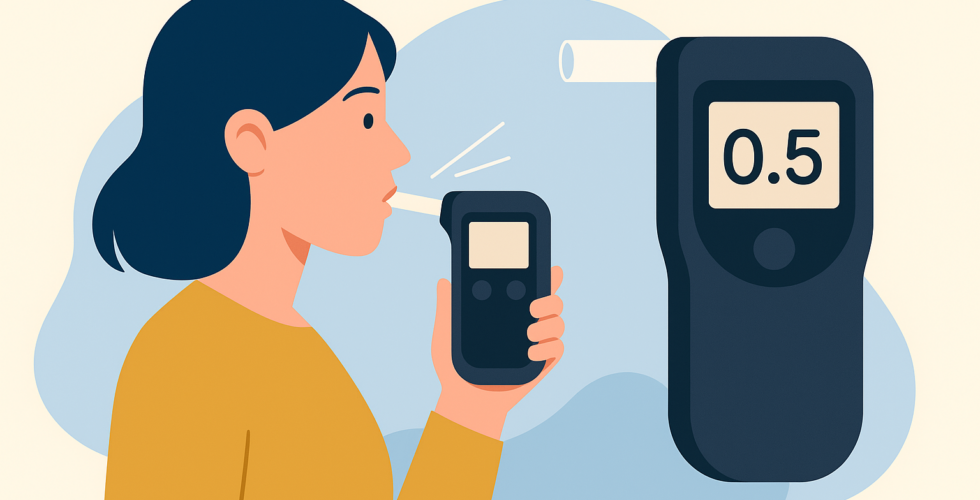
Blowing too hard, too softly, or for too short a time can prevent the device from properly analyzing your breath sample.
Why this is a problem:
- The device may show an error message, wasting a test.
- The result can be inaccurate, making you believe you are safe to drive when you’re not.
How to avoid this mistake:
- Take a deep breath before blowing.
- Maintain a steady breath for the required time (often 4–6 seconds).
- Use a clean mouthpiece for each test.
Pro tip:
Some models have visual or audible indicators to confirm that your breath pressure and duration are correct. Follow these cues carefully.
5. Thinking the breathalyzer replaces common sense
Common mistake:
Many believe that a reading below the legal limit means they can drive safely. In reality, alcohol starts to impair reflexes well before you reach that limit.
Why this is a problem:
- Even with a “legal” BAC, your alertness and coordination may be reduced.
- Fatigue, certain medications, or a heavy meal can intensify alcohol’s effects.
How to avoid this mistake:
- Use the breathalyzer as an indicator, not as a green light to drive.
- If you’ve been drinking, choose a taxi, rideshare, or designated driver—even with a low reading.
Real-life example:
Pierre blows 0.04% on his breathalyzer and decides to drive. Tired, he misses a stop sign and causes a collision. The number on the screen didn’t guarantee safe driving.
Best practices for reliable breathalyzer use
Beyond avoiding these five mistakes, here are extra tips for maximizing your breathalyzer’s accuracy:
- Storage: Keep the device away from humidity and extreme temperatures.
- Regular testing: Even if you’re not planning to drive, run a test occasionally to ensure it works properly.
- Familiarization: Learn to use it before you actually need it.
- Awareness: Remind others that a breathalyzer is an informational tool, not a license to drive.
Breathalyzer FAQ
1. Is a breathalyzer required in your car?
In France, yes (though there’s no fine if it’s missing). In Canada, it’s not mandatory but highly recommended.
2. What’s the difference between a breathalyzer and a breath analyzer used by police?
A consumer breathalyzer is for personal use. A police-grade breath analyzer is certified and more precise.
3. How long should you wait after drinking before using a breathalyzer?
At least 15 to 20 minutes.
4. Do coffee or a cold shower lower BAC?
No. Only time allows your body to eliminate alcohol.
5. How long does an electronic breathalyzer last?
Several years, with proper calibration and maintenance.
Conclusion
A breathalyzer is much more than a simple measuring tool—it’s a powerful ally in preventing impaired driving and protecting everyone on the road. However, it’s not a substitute for judgment and caution.
By avoiding common mistakes—testing too soon, skipping the instructions, using an expired device, blowing incorrectly, or relying solely on the displayed number—you improve the accuracy of results and make more responsible decisions.
Remember: even a reading under the legal limit doesn’t guarantee full alertness. Alcohol, even in small amounts, can slow reaction time, reduce concentration, and impair vigilance.
Key takeaway: If you’ve been drinking—however little—the safest choice is to arrange another way home: taxi, rideshare, public transit, or a designated driver. Your safety, and the safety of others, is worth it.

About Stéphane Maurais – Founder of Alco Prevention Canada
Since 1989, Stéphane Maurais has embodied passion, innovation, and determination in the service of road safety and the prevention of risks related to alcohol and drug use. Alongside his partner Ronald Chartrand—whose father tragically lost his life in a traffic accident in the 1970s—he founded Alco Prevention Canada, now recognized as a global leader in prevention solutions. These include certified single-use breathalyzers, electronic breath alcohol testers, drug screening tests, workplace health and safety programs, and event-based prevention tools.
Over a 36-year career, Stéphane Maurais has distributed millions of breathalyzers, helped save thousands of lives, and raised awareness among companies, government agencies, law enforcement, colleges, and universities around the world. He is also a pioneer in the fight against chemical submission, developing concrete tools to combat date rape drugs.
His commitment is unwavering:
“Every breath measured is a life protected. For 36 years, my mission has been simple: to save lives, one decision at a time.”
— Stéphane Maurais
Founder and President, Alco Prevention Canada